
Portable Compressor
D300PD2KR
300 CFM
The D300PD2KR is a dual pressure/dual capacity portable air compressor, capable of delivering 300 cfm at 100 psi or 230 cfm at 150 psi. At its core, a Tier 4 Final Kohler engine (no DEF fluid required) and a 130 mm diameter twin screw air end made by Sullivan-Palatek power the portable unit. Other features include a cooler access panel for cleaning, large toolboxes on each side with large service doors and lockable handles, a 30-gallon steel fuel tank, and a durable galvanneal enclosure with a powder-coated finish for rust and corrosion resistance. The compressor is also equipped with a state-of-the-art Sullivan-Palatek Electronic Controller (SPEC), providing digital readouts on everything from compressor temperature to complete engine diagnostics.
Distributor pricing by quote. Equipment pricing and availability are confirmed through authorized distributors. Request pricing
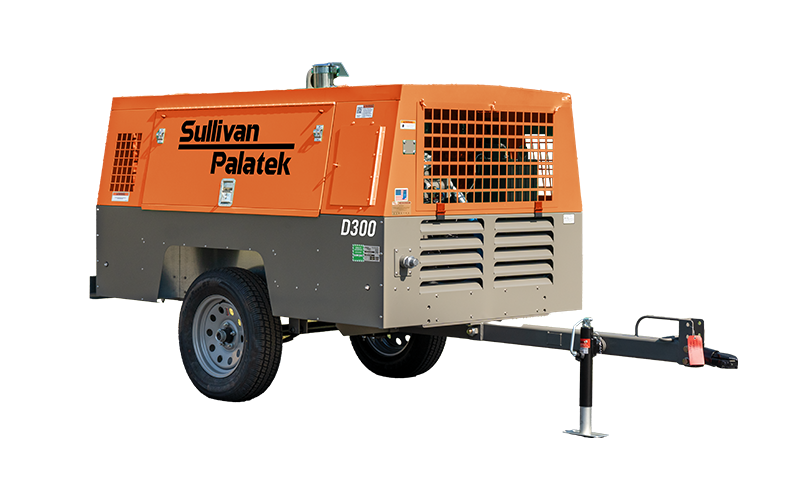
Built for dependable performance
Features & Benefits
- 74-hp Kohler Diesel Tier 4 Final engine
- Air end manufactured by Sullivan-Palatek includes a three-year warranty
- Dual pressure high-low selector valve
- 30-gallon steel fuel tank
- Durable galvanneal sheet metal enclosure with a powder coated finish for rust and corrosion resistance
- Large tool boxes on each side with lockable handles
Model data
Technical Specifications
| Model | Horsepower (hp) | Capacity (cfm) | Pressure (psi) | Engine Make |
|---|---|---|---|---|
| D300PD2KR | 74 | 300/230 | 100/150 | Kohler 2504 T4F |
Applications
- Sandblasting equipment
- Pipe testing
- Powering pneumatic construction tools:
- 3x 90lb class paving breakers for large demolition
- 4x 60lb class paving breakers for large demolition
- 4x 40lb class paving breakers for bridge deck repair
- 5x 30lb class paving breakers for light demolition
- 6x 30lb 8" rivet busters for bridge deck and medium demolition
- 5x 35lb class 11" rivet busters for bridge deck and heavy demolition
- 8x 15lb class 3" chipping hammers for light demolition and concrete restoration
- Restoration projects
Downloads
PORTABLE COMPRESSORS / SELECTION & APPLICATIONS
D300PD2KR: Select a 300 CFM Portable Diesel Compressor
The D300PD2KR is listed at 300 CFM and 100 PSI, or 230 CFM and 150 PSI. Evaluate its dual-pressure capability, job-site demand and package options together before choosing this portable diesel compressor.
Pair 300 CFM with 100 PSI
When the work needs 150 PSI, the published comparison point is 230 CFM. Keep those values paired when comparing the D260PDKR and D375PHKR, and identify whether the work needs more pressure, more airflow, or a different air-treatment arrangement.
Use application data instead of a universal tool count
The product description includes examples for construction tools, sandblasting, pipe testing and restoration. Treat those as application context, not an unconditional simultaneous-tool guarantee. Supply the exact tool or process demand and follow the relevant equipment procedures; this guide does not establish a testing method.
Prepare an equipment-specific options request
Review the listed hose reels, hitch and drawbar choices, brakes, cold-weather package and skid option. Discuss service-door access, fuel handling and transport with the distributor. Confirm the supplied configuration and manual revision before dispatching equipment.
Questions to Answer Before Choosing
What is the airflow at 150 PSI?
The D300PD2KR table lists 230 CFM at 150 PSI. The 300 CFM figure is its 100 PSI operating point.
When does a larger compressor make sense?
Review a larger capacity class when measured equipment demand at the required pressure exceeds the appropriate D300PD2KR rating. Also check hoses, distribution and treatment needs instead of assuming compressor size is the only constraint.
Where can I find the portable diesel compressor service manual?
Use the portable operation-and-service manual directory linked below and match the model, serial number and document revision. The sales sheet is useful for selection but does not replace the operation manual.
Application to equipment
Continue Your Compressed-Air Research
Connect this information with relevant applications, published equipment and technical references. Final equipment selection requires an application-specific review.