
Dual Pressure Portable Compressor
D185PDKR
185 CFM/100 PSI, 150 CFM/150 PSI
Our D185PDKR Kohler powered portable air compressor is now available with Dual Pressure. The 185 CFM/100 PSI, 150 CFM/150PSI unit features our Titan Top durable but lightweight composite clamshell canopy design for access to all routine serviceable components, such as the spin-on oil filter and separator. Compact in design, the unit is also equipped with a foldable drawbar to minimize its overall footprint in shipping and storage.
Internally the D185PDKR is powered by a 48.8 hp Tier 4 Final Kohler engine, a Sullivan-Palatek factory made 108 mm rotary screw air end at its core, side by side coolers for the compressor and engine, a large curbside toolbox for storage, a 10-hour full shift 30-gallon composite fuel tank with fuel level visibility, and a state-of-the-art curbside controller.
Distributor pricing by quote. Equipment pricing and availability are confirmed through authorized distributors. Request pricing
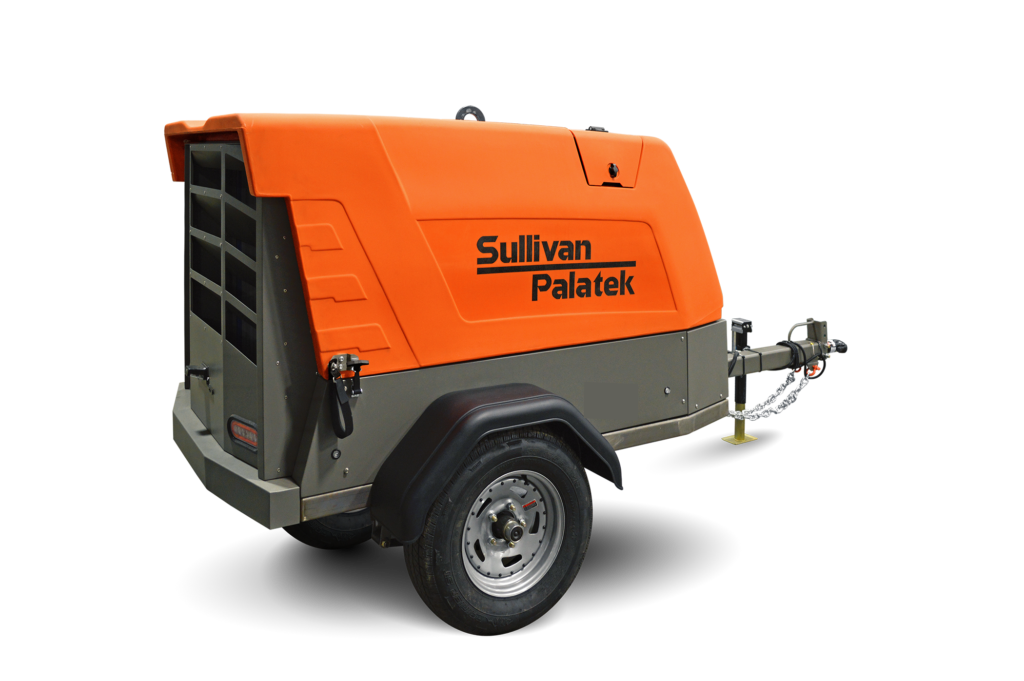
Built for dependable performance
Features & Benefits
- Lightweight composite clamshell canopy design offers both strength and improves access to all routine serviceable components
- A smaller footprint and foldable drawbar make shipping and storing a great advantage
- A wider wheelbase provides improved balance and stability on the highway and job site
- Air end manufactured by Sullivan-Palatek includes a three-year warranty
- Composite full shift 30-gallon fuel tank with fuel level visibility
- Sullivan-Palatek Electronic Controller (SPEC)
- LED tail lighting
Model data
Technical Specifications
| Model | Horsepower (hp) | Capacity (cfm) and Pressure (psi) | Engine Make |
|---|---|---|---|
| D185PDKR | 48.8 | 185 CFM @ 100 PSI / 150 CFM @ 150 PSI | Kohler D1903 T4F |
Applications
- Sandblasting equipment
- Construction
- Road construction
Downloads
PORTABLE COMPRESSORS / SELECTION & APPLICATIONS
D185PDKR: Match Dual-Pressure Airflow to the Application
The D185PDKR has two distinct published operating points: 185 CFM at 100 PSI and 150 CFM at 150 PSI. Its selection guide focuses on using the correct airflow and pressure pair for construction, road work and other applications covered by the model documentation.
Compare capacity at the selected pressure
The higher-pressure setting has a different airflow rating. When comparing a 185 CFM-class portable for a 150 PSI requirement, the D185PDKR rating to use is 150 CFM at 150 PSI. Check that point against the connected equipment demand before choosing the machine.
Review Titan Top access and job-site needs
The published design includes a composite clamshell canopy and foldable drawbar. Review routine access, transport dimensions and the exact machine specification with the supplier. Shared appearance with another 185 CFM model does not establish identical operating capability.
Check the quoted seasonal configuration
The model options identify hitch choices and a cold-weather package. Confirm which items are on the proposed unit and use the correct operation and engine manuals. Do not infer an approved starting temperature or installation procedure from the presence of a cold-weather option.
Questions to Answer Before Choosing
Is the D185PDKR a 185 CFM compressor at both pressures?
No. The published pair is 185 CFM at 100 PSI and 150 CFM at 150 PSI. These values must stay paired in comparisons and quotations.
What should I compare when 150 CFM at 150 PSI is not enough?
Review the D210PHKR and larger dual-pressure models at the same required operating pressure. Increasing the model size alone is not a substitute for confirming capacity at the chosen pressure.
Can one model cover several rental applications?
Potentially, when each application fits a documented operating point and the exact package. Record the tool or process requirements and review the intended use with the supplying distributor; this page is not a pressure-testing procedure.
Application to equipment
Continue Your Compressed-Air Research
Connect this information with relevant applications, published equipment and technical references. Final equipment selection requires an application-specific review.
Related industry applications
Supporting technical reading
Verify specifications and treatment
Explore specific uses
Applications for This Equipment or Industry
Follow these practical guides to compare tasks, demand patterns, air treatment and application-specific specifications.